


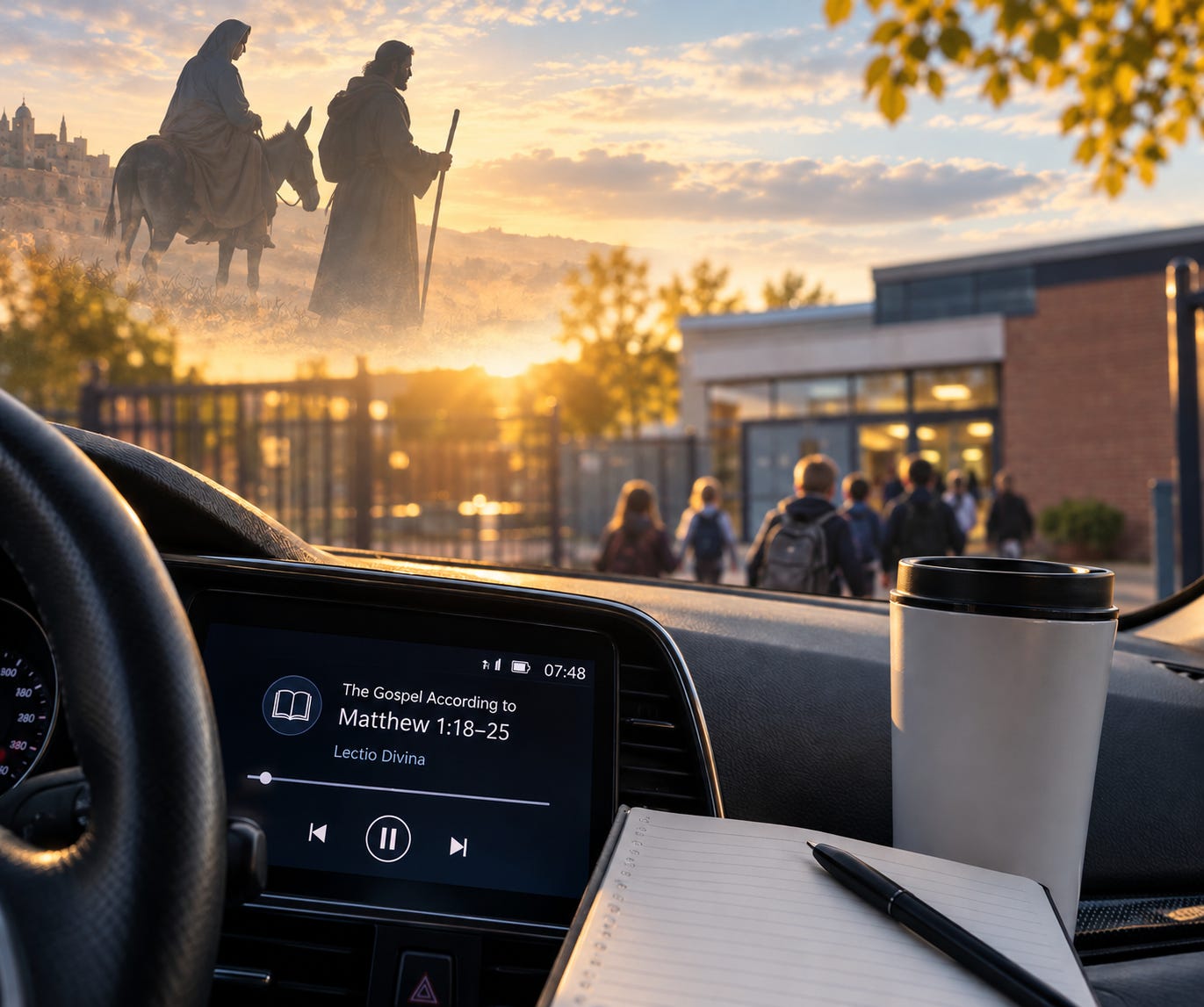
I’ve been using an audio app lately, which allows me - amongst other things - to listen to a daily Gospel reading as I drive to work. The app in question allows you to choose anything between a 5 minute whistle-stop Gospel reading, all the way up to a half an hour Lectio Divina with plenty of silences for reflection in between repetitions of the passage.
My satnav advised 32 minutes - with traffic - to get to school. So with this in mind, I swung the app settings to the longer version of the day’s reading and settled in to my journey, consoled by the fact that my longer-than-normal, stop-start commute would at least be wrapped in a bubble of divine serenity.

The reading began and an air of familiarity swamped the car as the quickly recognisable words of Matthew 1 drifted from the speakers.
The key moment is when Joseph has decided to divorce Mary quietly and the angel appears to him in a dream:
Matthew 1:20–21 (ESV)
“Joseph, son of David, do not fear to take Mary as your wife…”
The angel explains that the child conceived in Mary is from the Holy Spirit, tells Joseph to name him Jesus and says he will “save his people from their sins.”
Then Matthew 1:24 gives Joseph’s response: he wakes up and does exactly what the angel commanded, taking Mary as his wife.
Then silence. A long silence.
I instinctively glanced at the in-car screen to see if my cellular signal had dropped.
It hadn’t.
Ohhhhhh! This is the part where I’m meant to reflect?
Meditate on what I’d just heard.
Connect with God.
Ok, well…
Erm… It was good of Joseph, I guess. Kind of noble, I suppose. Well done, Joseph!
That was literally all I had. My pathetic attempt at meditation on the word of the Lord in the five minutes of silence the app afforded me before the passage played a second time. Then a third. The same weird, pointless silence punctuating every repetition of the short reading. By the final round of silence, I was contemplating a pretty much wasted 32 minutes of unproductive car time. My mind drifted away from the Lord and back to work. School. The children I was about to teach. A new school year with a new cohort. Challenging inner-city kids, trying their luck with me all week. Testing my boundaries to see how much flex could be found in the rules and expectations I had stubbornly spelt out to them a couple of days earlier.
The membrane of my bubble of divine serenity had been violated by the harshest of pins. Reality. Work. Stress incoming.
I pulled on to the school car park and for reasons I can’t explain, I sat for a while and my mind wandered back to the Gospel.
Joseph had been entrusted with a child whose arrival had disrupted his plans completely. Whatever fear, embarrassment or confusion he felt, Matthew records his response with remarkable simplicity: “he did as the angel of the Lord commanded him.” He accepted the responsibility God had placed before him and became the earthly father of a child who belonged, in the most profound sense possible, to God.
A phrase entered my head that felt like it came from outside and somehow provided a bridge between Joseph’s situation and my upcoming battle with the inner-city youth.
“Steward my children.”
Of course, the comparison only stretches so far before becoming ridiculous. I was sitting in a Dacia Sandero preparing to teach Year 6, rather than contemplating the small matter of raising the Messiah. Still, there was something in Joseph’s response that I suddenly recognised as relevant to the job waiting for me beyond the school gates. I had spent the week wondering what sort of class I had been given, when perhaps the more useful question was what I was going to do with the children I had been entrusted with.
Because they were entrusted to me. For six hours a day, five days a week and the best part of a year, these children would spend an enormous portion of their waking lives in my classroom. Their parents would send them through the gates each morning and, for those hours, I would have an extraordinary amount of influence over the way they saw themselves, the things they believed they were capable of and, to some extent, the adults they would eventually become. Viewed like that, teaching began to feel less like managing a room full of difficult personalities and more like stewardship. Stewardship of something belonging to God.
The phrase stayed with me throughout the day. It was there when I was teaching, when I was correcting behaviour and when somebody inevitably did something I had specifically asked the entire class not to do approximately thirty seconds earlier. Each time I felt the familiar irritation rising, I found myself returning to the same thought: Steward my children.
That didn’t mean lowering expectations or smiling serenely while somebody dismantled a glue stick underneath the table. Stewardship, I realised, included boundaries, consequences and occasionally telling somebody for the fourth time that a ruler was neither a musical instrument nor a weapon. These children deserved all of those things because caring for something properly sometimes requires considerably more effort than simply being nice to it.
The phrase also began to alter the way I looked at them. The child testing every boundary was still one of God’s children. So was the one who struggled to sit still, the one whose bravado concealed insecurity, the one who arrived angry before I had even taken the register and the one whose behaviour could exhaust my patience before nine thirty in the morning. I knew very little about what some of them carried into that classroom each day (it was only my third full day with them) and yet here they were, placed in my care for this small but significant stretch of their lives.
By home time, the class itself hadn’t changed particularly dramatically. They were still noisy, funny, complicated, occasionally infuriating eleven-year-olds, and I suspect several of them are at home as I type this, quietly committed to thinking of new and inventive ways to uncover whether any undiscovered loopholes existed in my behaviour policy. What had changed was the way I understood my place among them.
Perhaps that was what Joseph had given me that morning. He had been presented with circumstances he could not possibly have chosen or fully understood, yet once he recognised that God had entrusted something to him, his response became one of faithful responsibility. I could hardly claim the same clarity of divine instruction from a thought in a car park, but the principle had lodged itself firmly enough in my mind to reshape the day ahead.
I had driven to work expecting half an hour of divine serenity before returning reluctantly to reality. Instead, the strange silences I had spent most of the journey resenting had allowed an ancient story to follow me all the way into my classroom.
Steward my children.
It stayed with me then, and it has stayed with me since.