


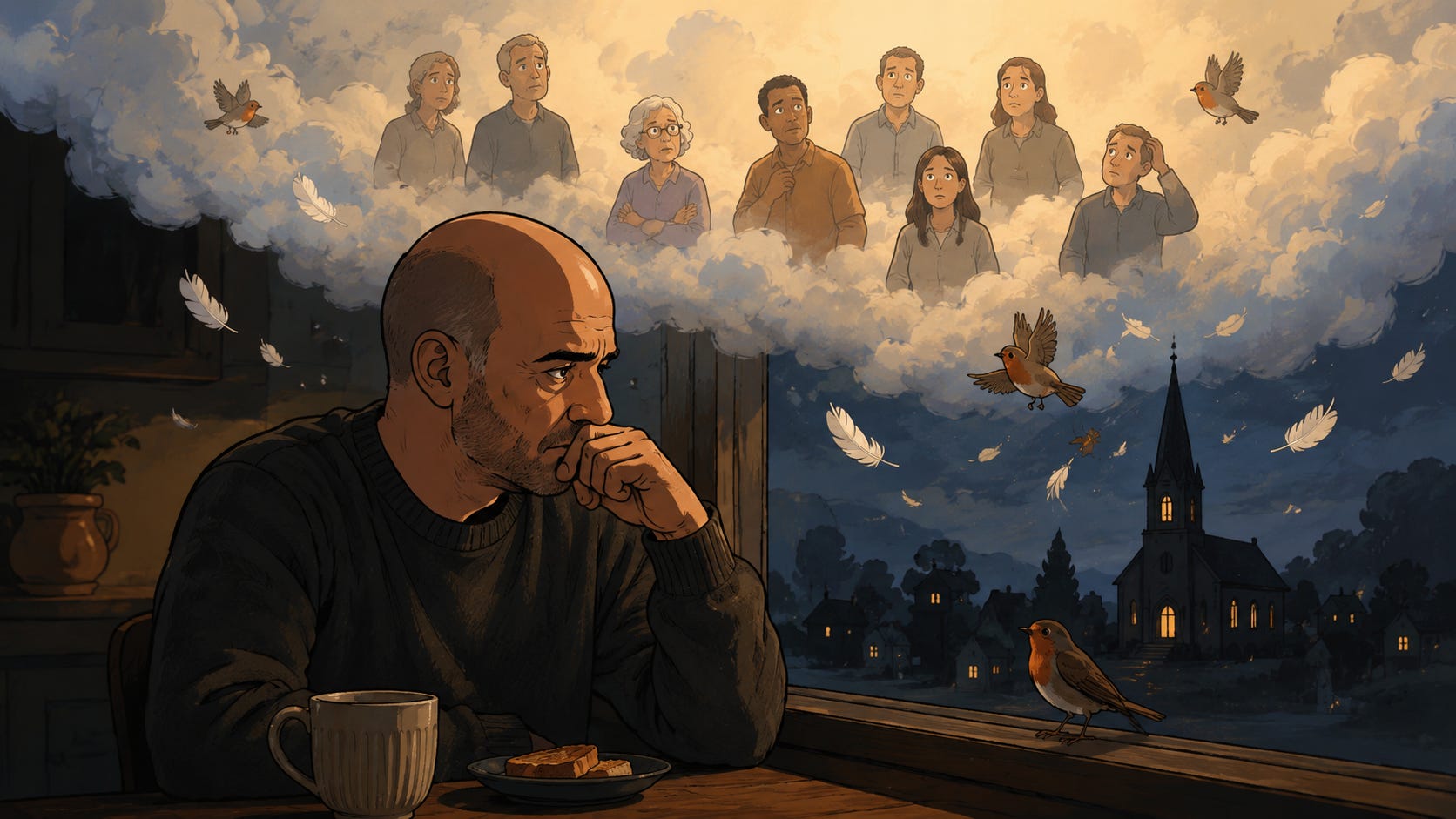
There’s a sentence people say to me quite a lot now.
“I’m glad the church is bringing you comfort.”
It’s kind. I know it is. I don’t think anyone is having a dig. Most people are just trying to be decent, which is fair enough, especially when grief is involved and nobody really knows what to say without sounding like they got their emotional training from the inside of a greetings card. Still, the line sits strangely with me, because I’m not sure comfort is the main thing that has happened.
Comfort is part of it, obviously. Church has brought me comfort. Prayer has. Scripture has. Sitting in a pew when my head has been all over the place has. I’m not going to pretend otherwise just to sound more theologically impressive (which would be a doomed mission anyway). The bigger problem is this:
I think the Gospel is true and if I’m right, it should be the most important thing to any of us.
And that’s where everything gets more awkward.
After my Mom died, people started talking about signs. Robins. Songs. Coincidences. Little moments that seemed too well timed. There’s also the psychic night in the book, which quite a few people seemed willing to treat as something supernatural and real.
I understand that instinct completely.
When someone you love dies, you want some evidence that they haven’t just vanished. You want a crack of light somewhere. A hint. A nudge. Something that says love hasn’t been wiped off the face of the earth by one horrible phone call.
I didn’t have a carefully worked-out view of the afterlife before all this. I hadn’t rejected it after years of deep philosophical study. I just hadn’t given it much thought, which is probably how a lot of us live. Death sits somewhere in the background, like a bill you know exists but keep refusing to open.
Then it opens itself.
Suddenly everyone has language for what comes next.
“She’s still with you.”
“She’ll be watching over you.”
“She’ll send signs.”
“She’ll be up there with your Nan.”
Again, I’m not sneering at that. Some of it helped. Some of it still does. A few things happened after my Mom died that I still don’t know what to do with, and I’m not about to flatten all of it down just so I can sound neat and sensible.
The bit I can’t shake is this.
Why are signs from the dead easier to accept than the Gospel?
A robin can be meaningful. A dream can be loaded. A strange coincidence can make everyone go quiet and awestruck for a second. A psychic can say something and people will hang on their every word.
Then you mention Jesus rising from the dead and everyone starts acting like you’ve brought a tambourine to a business meeting.
I find that strange.
Because the issue clearly can’t be the supernatural. Plenty of people are open to “something more” when it’s convenient. What seems harder to accept is a God who has actually revealed Himself; a God with a name, a claim, a cross, an empty tomb, and something to say about how we live.
That asks more of us.
A vague afterlife can comfort you without interrupting you too much. It lets you imagine reunion, love carrying on, maybe the odd sign here and there, while leaving your normal life mostly untouched. Nobody has to repent because a song came on at the right moment. Nobody has to forgive their enemy because a robin landed on the fence.
Christianity doesn’t leave it there.
That is probably why people keep it at arm’s length. I get it. Honestly, I do. If Christianity is true, it isn’t just a nice emotional crutch for grieving people. It changes the whole picture. Death, love, sin, mercy, judgement, forgiveness, worship, eternity - all of it comes into view properly, and most people would rather politely pretend it wasn’t a thing.
Me included, for most of my life.
I wasn’t walking around thinking deeply about God every day. I was busy, distracted, tired, anxious, trying to be a decent dad and husband, going to work, watching football, making jokes, scrolling my phone, and generally avoiding the massive question waiting at the end of everything.
Then my Mom died.
And after that, death stopped being an idea.
So when people say they’re glad church is helping me, I do appreciate it. I really do. There’s love in that sentence. Part of me still wants to ask, though: what do you think is actually happening here?
If my Mom is still alive in some sense, where is she?
If signs are real, who allows them?
If love survives death, what is it rooted in?
If there is an eternity, why would God be the least interesting part of it?
That last question has been bothering me.
An afterlife without God sounds comforting for about ten seconds. Then it starts to feel strangely thin. Who holds it together? Who decides what happens there? What happens to evil? Is everyone just floating around vaguely fine forever? Does forgiveness matter? Does truth matter? Does anything get judged, healed, restored, answered?
I know these are big questions. I also know they are exactly the sort of questions people avoid because they make normal conversation weird. Nobody wants to be standing near the kettle at work while someone starts weighing up eternal judgement between spoonfuls of instant coffee, which is fair enough.
Still, I don’t think we can keep borrowing Christian hope while treating Christianity itself as a bit embarrassing.
That is what I feel like we do sometimes. We want heaven at funerals, signs in grief, reunion after death, love stronger than the grave, and the comforting thought that the person we lost is somehow safe.
Then God becomes the awkward part.
Surely that’s backwards.
If my Mom is safe, I want to know who she is safe with.
That isn’t me trying to win an argument. It’s the thing I can’t stop coming back to. The Gospel doesn’t just give me a softer way to think about death. It gives me Christ. And Christ doesn’t feel like a vague coping mechanism. He feels like someone I kept trying to avoid, only to find Him standing at the centre of the question when I canned my ego enough to look properly.
That sounds dramatic. I know.
It also sounds true.
Maybe that is why the “comfort” line catches in me. It makes faith sound private and optional, like something useful for the grieving bloke who has had a rough year.
But if Christ is risen, then eternity isn’t just a nice thought for when someone dies.
It’s the reality of how existence works.
And if it’s reality, then none of us can afford to treat it like someone else’s coping strategy.
So true! It is crazy that people can be so open to crazy stuff but then treat you bringing up Jesus as crazy!