

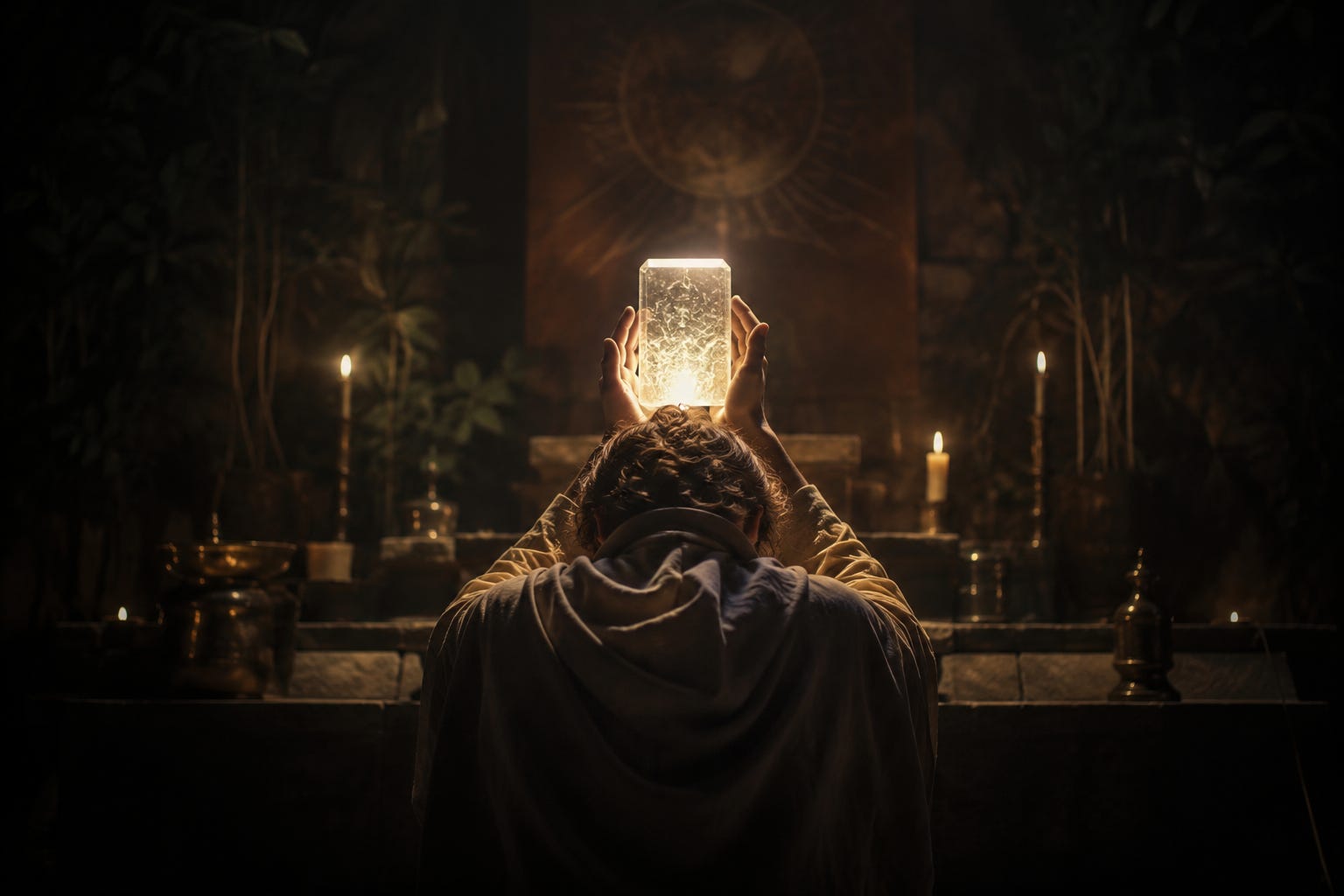

For years, I couldn’t understand Christianity.
People voluntarily giving up their Sunday mornings. Singing songs to someone they couldn’t see. Speaking into silence with the confidence they were being heard. Eating bread and drinking wine because of events that happened long before they were born. Ordering their marriages, careers, finances and friendships around an ancient collection of writings because they believed God had spoken through them.
I’d look at all of it and think, This is a bit strange.

Then, while reading about world religions recently, I stumbled across one I’d somehow never heard of.
Its followers revere an idol known simply as the Lumen.
Unlike most sacred objects, the Lumen isn’t kept inside a temple or brought out only for religious festivals. Devotees carry it with them at almost all times, believing that prolonged separation causes unease and vulnerability. Many sleep with it within arm’s reach. Some become visibly distressed if they discover they’ve left it behind, abandoning journeys and important appointments to retrieve it.
The rituals surrounding the Lumen are extraordinary.
Traditional religions might ask for prayer once, twice or five times a day. Followers of the Lumen perform acts of devotion hundreds of times, often without conscious thought. The slightest prompting from the idol is enough to interrupt meals, conversations, celebrations and moments of quiet reflection. It is considered perfectly acceptable to stop listening to another human being if the Lumen calls.
Its influence over the emotional life of its followers is remarkable.
Small symbols appearing upon its illuminated surface are interpreted almost as omens. Certain signs produce delight. Others provoke anxiety, envy, anger or despair. Entire days can be transformed by a handful of marks delivered by the idol. If its inner light begins to weaken, worshippers immediately begin searching for places where its strength can be restored. Watching them, you’d be forgiven for thinking their own life depended on it.
The Lumen also has a priesthood of sorts. Countless voices interpret its messages, instructing followers what deserves admiration, outrage, fear and desire. Most accept these directions without question, returning to the idol again and again throughout the day lest they miss the latest revelation.
Anthropologists often point out that the easiest religion to overlook is your own.
That’s been rattling around my head for a while.
I spent years thinking Christians were the peculiar ones because they prayed before meals, sang hymns and tried to place God at the centre of their lives.
Then I walked through a city centre.
Thousands of people, heads bowed in quiet reverence. Eyes fixed on a glowing object cradled carefully in their hands. Joy, anger, comfort and identity flowing from whatever the Lumen chose to reveal next.
It suddenly occurred to me that I’d seen this congregation countless times before.
The Lumen isn’t real.
At least, the name isn’t.
The worship is.