


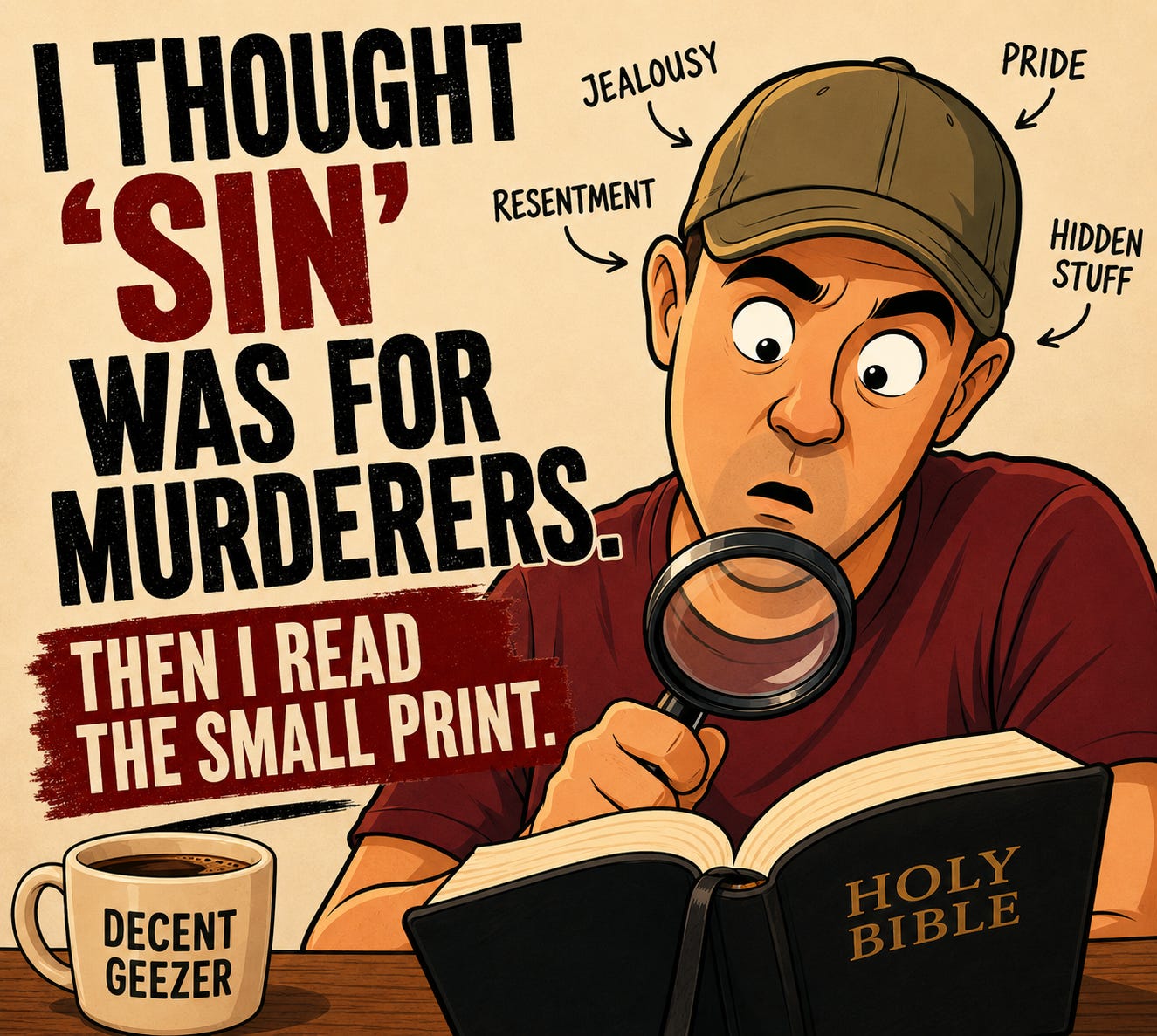

For years, I assumed sin was one of those old church words reserved for murderers, dictators and people who put milk in before the tea bag.
It sounded dramatic. Sin. Proper capital-S stuff.
I wasn’t out robbing pensioners or pushing old ladies into canals. I went to work, loved my family, paid my bills and occasionally pressed ‘yes’ when the card machine asked if I wanted to donate 25p to charity.

By my own standards, I was doing alright.
Then I started reading what the Bible actually says, and apparently, merely avoiding prison isn’t the complete moral benchmark.
Because as well as the massive crimes, He seems just as interested in why I’m still annoyed three days later that somebody spoke to me like I was thick. Why I’ll happily help somebody out, right up until it means changing my own plans. Why I can say “No, honestly, it’s fine” while mentally adding a person’s name to a list of people who’ve let me down. Why I’m pleased for somebody’s good news for the first seven seconds, before wondering why it never happens to me. Why I’ll do something kind, then quietly hope somebody notices. Why I can spend an entire day being perfectly polite while internally finding fault with nearly everyone I meet.
That feels unfairly detailed, to be honest.
I preferred my old version of morality: avoid prison, don’t be horrible to animals, put your trolley back. Job done.
Christianity, however, seems less interested in whether I can pass as a decent bloke from a distance. It wants to know what’s going on when nobody’s clapping, nobody’s watching and I’ve got absolutely nothing to gain.
“People look at the outward appearance, but the Lord looks at the heart.”
1 Samuel 16:7
Which is where it becomes a bit less like a list of rules and more like somebody has been given access to the group chat going on in my head.
Turns out, sin isn’t just a word for the sort of person who ends up on Crimewatch. It’s why ordinary people — people who love their families, pay the gas bill and return the odd trolley — can still say cruel things, keep score, dodge apologies and make a mess of the people closest to them.
It’s why “I’ll never do that again” seems to have the structural integrity of a Lidl gazebo in an October gale.
Which is not ideal news for someone who had built quite a lot of his identity around being a decent geezer.
Still, I suppose it’s useful to know the diagnosis.
Especially if somebody has already offered the cure.
https://substack.com/@kellygreen232127