


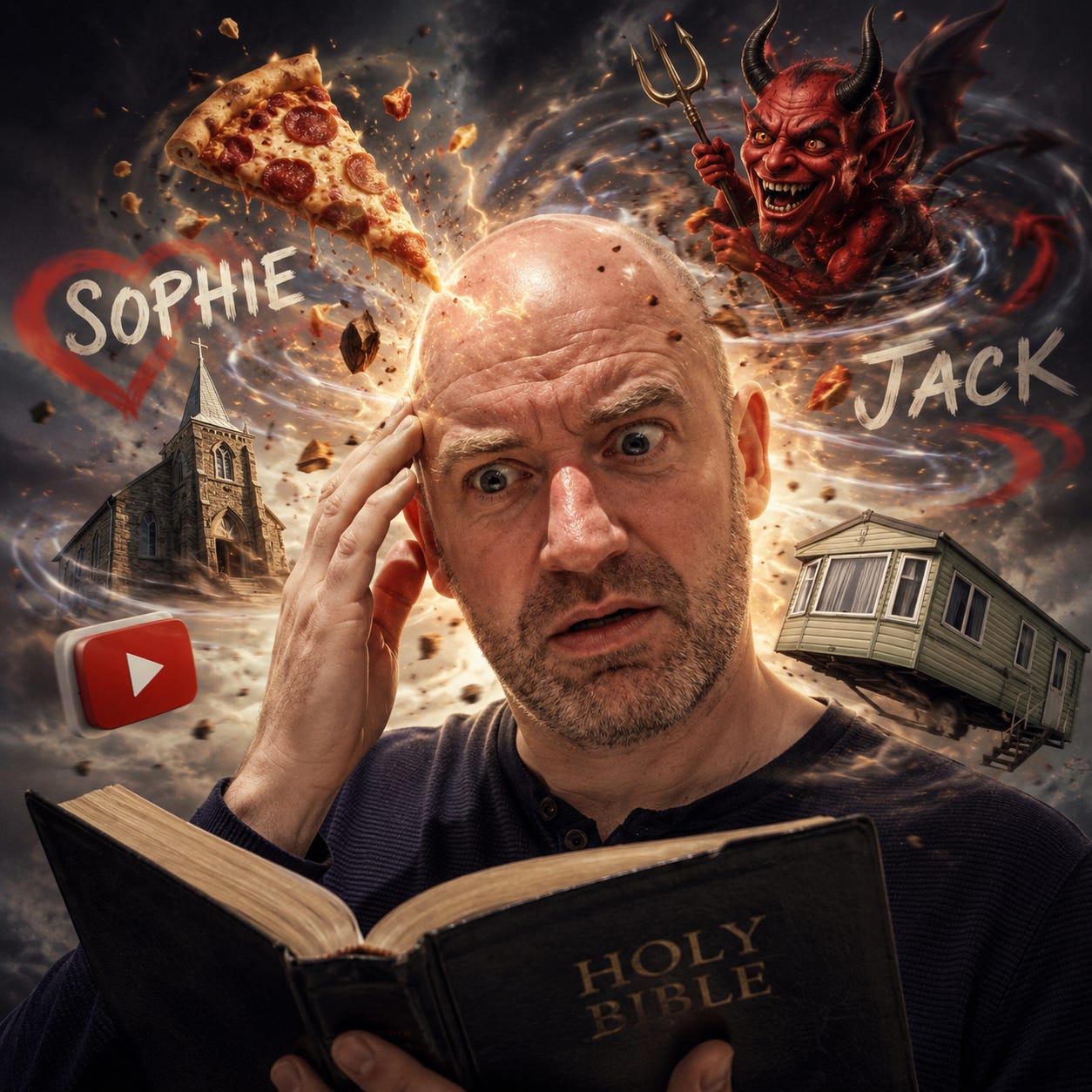
Did I really find God, or did grief just break my brain? That is probably one of the fairest questions anyone could ask about my story. It is also one of the questions I have had to ask myself, because if a man with no real interest in religion suddenly loses his mom, starts walking into church, begins reading the Bible, and then writes a book about faith, grief and providence, claiming he found God along the way, there is an obvious cynical response available.
“Of course you did, mate. Grief’ll do that to you.”
That response is not even close to stupid. Grief does strange things to a person; it messes with time, memory, judgement, appetite, sleep, patience and your general ability to function like a normal member of society. It can turn completely ordinary things into emotional traps. A song. A smell. A photo. A message. A bit of furniture. You can be doing all right, or at least doing a decent impression of someone doing all right, then suddenly something tiny catches you sideways and you are gone. I specifically remember being relatively strong throughout Mom’s funeral, yet spiralling badly a fews later when I was in a petrol station and saw a bag of jalapeño pretzel bites we once shared and agreed were amazing. There is no rhyme or reason to it.
So yes, grief changes the way you see the world. I would be lying if I pretended otherwise. The real question is whether grief only bends reality out of shape, or whether it can also break through the noise and force you to look at something you had been avoiding. In my case, that “something” was Christianity. Not vague spirituality. Not a comforting blur. Christianity - with its claims, its questions, its cross, its resurrection, and its insistence that death doesn’t get the final word.
Before all this, I did not have a thoughtful, quietly spiritual background. I was not hovering around the edges of Christianity, waiting for the right moment to commit. Religion was not a major interest of mine. I did not spend evenings weighing up the resurrection evidence, comparing denominations, or wondering whether the Psalms might one day explain my life. I barely thought about it at all.
…grief changes the way you see the world. I would be lying if I pretended otherwise
God, church, faith, prayer, Scripture - all of it belonged in a category I had not seriously opened. I knew religion existed, obviously. I knew bits from school, weddings, funerals, Christmas services and the general cultural fog of growing up in England. That was about it. It was background noise. Something other people seemed to care about. Something I could acknowledge from a distance without ever having to let it ask anything of me.
Then grief came along and made the distance collapse. I wasn’t wandering gently towards faith with a curious little expression on my face. I was shoved into it sideways - ambushed in a direction I would never have imagined myself going. Some people might call that the work of the Holy Spirit. Others might roll their eyes and call it grief doing what grief does. Either way, I couldn’t unsee what had started opening up in front of me.
Suddenly the questions were not abstract anymore. What happens when someone dies? Where do they go? Why does love feel too real to be reduced to biology and memory? Why does the absence of one person make the whole world feel morally wrong? Why do we ache for meaning if there is none? Why, in the middle of all that pain, did I feel as though something had moved closer rather than further away?
That last question is the one I find hardest to dismiss.
I did’t go looking for a religious rebrand. I wasn’t trying to become a walking testimony or reinvent myself as the kind of bloke who suddenly has a favourite minor prophet and uses “fellowship” as part of his daily lexicon. I was still me: overthinking, awkward, emotionally chaotic, sometimes loving, sometimes useless, often trying to treat practical jobs and unsolicited research into Christianity as a substitute for actually feeling anything.
And what started as a distraction quickly became a rabbit hole; and somewhere down that rabbit hole I found a lot more truth than I bargained for. So much so, that I quickly realised that rather than escaping from reality, I was being dragged towards it.
That did not happen because everything suddenly made perfect sense. If anything, faith made the whole thing more serious. It did not take the grief away. It gave the grief somewhere to go. It gave the questions a direction. It gave the ache a language. The world did not become less painful, but it did become less empty.
That distinction is important.
People sometimes talk as if belief is just a comfort blanket for people who cannot cope with reality. I understand the accusation. I really do. From the outside, my story could look like that. Grief happens, religion appears, man concludes God is real. Case closed. Brain has clearly gone for a walk.
I quickly realised that rather than escaping from reality, I was being dragged towards it.
Except that is too easy.
In my case, grief did not make me float away from reality. It made me pay attention to it. It made some of my old assumptions look flimsier than I had realised. The version of life where everything is ultimately accidental, love is just chemistry, death is just the end, and meaning is something we politely invent to get through the day suddenly felt nowhere near big enough for what I was experiencing.
Love felt too real.
Loss felt too wrong.
The longing felt too deep.
The pull towards God felt less like panic and more like recognition.
That is the best word I have for it: recognition. Not proof in the courtroom sense - although I have unearthed plenty of stuff along the way that comes close to that (there’s a ‘receipts’ chapter at the end of my upcoming book that details this). It’s sort of like hearing a tune you somehow already knew before it started playing.
So did I find God, or did grief break my brain?
I think grief broke something, but I don’t think it was my brain. I think it broke the distance that had allowed me to keep Christ safely vague. Before all this, I could leave God in the background, because I had never really been forced to deal with Him properly. Faith was something other people messed around with. Jesus was a name I knew from teachers at school. Death was a sad fact I sort of understood in theory.
Then actual grief made theory useless.
Suddenly, Christ was standing right in front of the wound: death, love, loss, meaning, hope, resurrection. All the things I had managed to keep abstract became painfully specific. Grief did not invent God for me. It made it much harder to keep pretending the claims of Christianity had nothing to do with my actual life.
Through that break, faith eventually began to feel less like an idea I was considering and more like a reality I was being invited into.
That is part of why I wrote The Pizza Place Providence.
The story is not just that grief happened.
The story is what grief opened.