


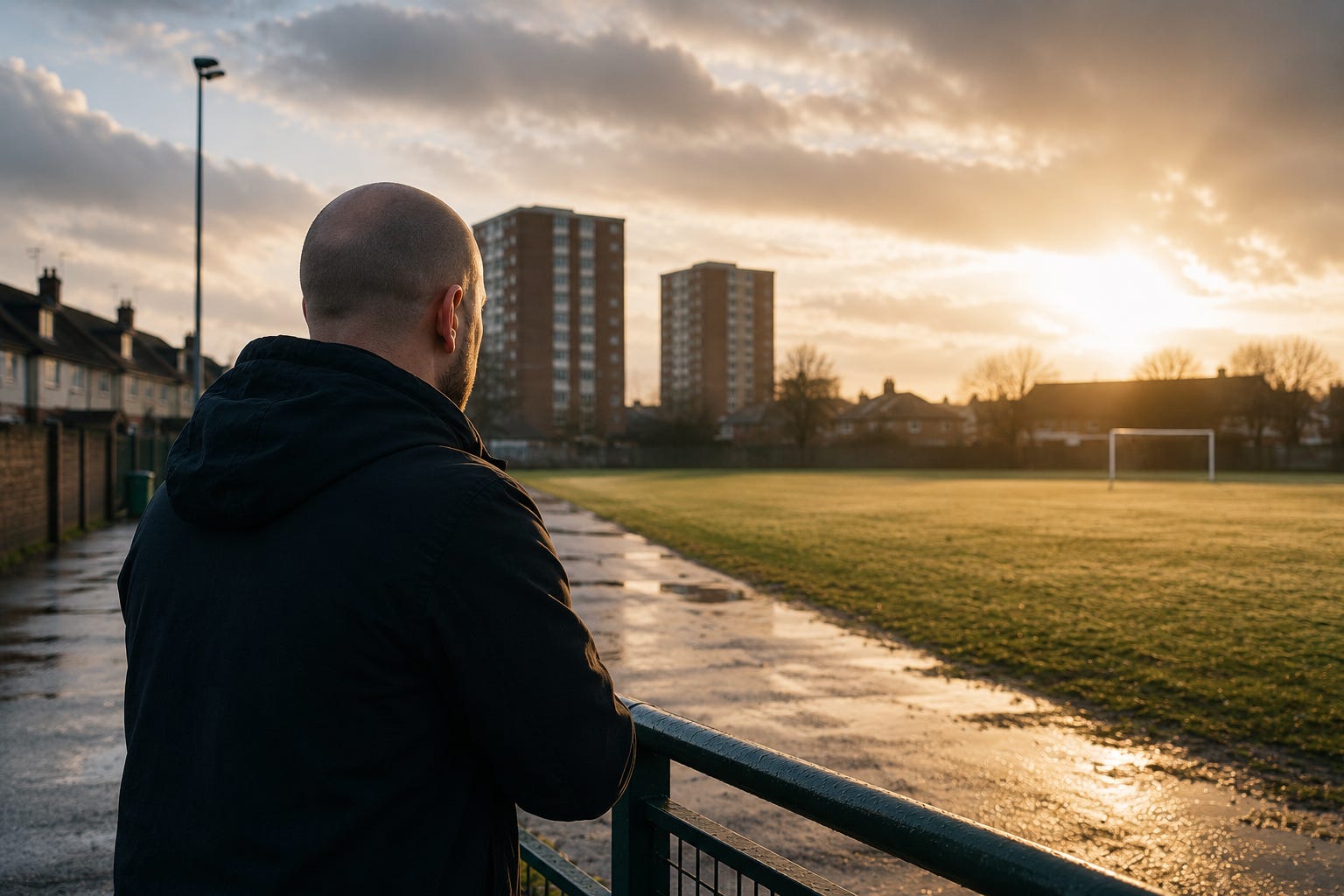
The bit I’m trying to work out is this: can Christ change me without turning me into someone my own people don’t recognise?
That is the real question for me.
I’m not writing this from the edge of belief, peering in like someone outside a pub trying to decide whether the atmosphere looks friendly. That part, strangely enough, feels more settled than I expected. Books helped. The Gospels did more. Somewhere along the way, Christianity stopped being an interesting argument and became a reality I couldn’t honestly dodge anymore. I’m a believer!
So the question has changed.
It is no longer, “Do I believe this?”
It is, “What is this going to do to me?”

That is a much more uncomfortable question, because belief can stay in your head for a while and behave itself. It can sit there looking clever, nodding along to C. S. Lewis, enjoying the odd podcast, getting mildly emotional during a hymn. But if Christ is real, He does not stay politely in the “interesting thoughts” section of your life. He starts walking around the house.
Opening doors.
Pointing at things.
Asking why you’ve kept that in your life.
This is where I get a tad nervous.
I come from a world where faith was not part of life. My family were never religious. There were no Bible verses on the wall, no prayers before meals, no church calendar quietly shaping the year in the background. God, if He came up at all, was more likely to appear in a throwaway comment of exasperation than a serious conversation. My roots are ordinary, working-class, council-estate-adjacent, football-on-the-telly, family-first, take-the-mick-before-you-say-anything-too-sincere roots.
That world made me.
I don’t want to lose the stuff that feels like home. The humour, mainly - that banter rhythm where affection comes wrapped in abuse, and somehow everyone in the room understands the difference. Football matters too, because I come from a life where having a few choice words to shout towards a referee about his substandard level of officiating is seen as a perfectly normal let-your-hair-down activity. Then there’s the music - that clever indie stuff with grit in it, the songs that manage to say what you feel without making you sound like you’ve been journalling in a candlelit yurt. All of that feels woven into me, and I’m trying to work out what Christ wants to clean up rather than what He wants to erase.
“I don’t want to lose the stuff that feels like home.”
I don’t want to lose all that.
There, I’ve said it.
Part of me is loath to give any of it up if iI’m brutally honest. I want to follow Christ properly, and I mean that seriously, yet there is still a part of me quietly hoping He doesn’t ask me to become the sort of bloke I would previously have avoided at weddings.
It frightens me more than I’d like to admit.
The fear is not really that Christianity will make me good. It’s that it might make me false. Or, more accurately, that I might make myself false while trying to look good at Christianity.
There’s a difference.
Jesus trumps all of it. I know that. If He is Lord, then He is not Lord of the tidy, church-friendly bits while the rest of me gets kept in a drawer marked “personality.” He gets the lot. The humour, the pride, the temper, the football-mouth, the family loyalties, the old instincts, the bits I’m fond of and the bits I’ve spent years pretending are just harmless quirks.
Still, is it wrong to hope - just a little - that He leaves some of it untouched?
Maybe untouched is the wrong word. Maybe what I really mean is unharmed. Redeemed rather than erased. Cleaned up without being turned into something bland. I don’t want to cling to sin and call it character, because that would be a coward’s trick. But I also don’t want to mistake becoming holy for becoming dull, distant, or weirdly polished in a way that would make my own family wonder who had walked into the room wearing my face.
But some of what I call “me” probably does need to die. Pride has often dressed itself up as principle. Sarcasm can pretend to be humour when really it is just a way of staying untouchable. Loyalty, which is beautiful when it protects people, can become ugly when it refuses to admit fault. Even banter has a line, and I know full well I’ve crossed it before while pretending everyone else should just lighten up.
Faith has started making those excuses harder to keep.
Christ doesn’t seem interested in being added to my existing personality as a tasteful accessory. He is not a little cross on the dashboard while I carry on driving wherever I fancy. He wants to take the wheel and drive us places, which sounds lovely in a worship song and slightly alarming when it starts affecting your actual reactions, habits, grudges, ambitions and mouth.
That’s where the identity crisis starts to get real. Saying “I’m a Christian now” is easy enough when the sentence sits safely on a page. Living it around people who knew you before is different, because family have receipts. Your tone, your history, your little tells when you’re tired or defensive, the generous bits and the selfish bits, the moments when you’re loving and the moments when you’re being a complete idiot - none of it is hidden from them. You cannot rebrand yourself in front of family; they’ve still got the old packaging.
Maybe that is a mercy.
It stops you getting carried away with your own conversion. Maybe it’s meant to be a slow and steady thing.
The strange thing is that my inward conviction is stronger than my outward confidence. Inside, I know. Outside, I am still learning how to say it without sounding like I’ve borrowed someone else’s coat. Faith sits deeply in me now, yet expressing it can still feel awkward, as if my old self is watching from across the room with a pint, going, “Listen to you, mate.”
“Christ doesn’t seem interested in being added to my existing personality as a tasteful accessory.”
That split-personality turmoil is probably the honest place to write from.
I believe, and yet I am still learning how to inhabit belief.
The question, then, is whether Christ makes me less myself or more truly myself. I don’t mean that in a cheesy fridge-magnet way. I mean it in the hard sense. If grace strips away the pride, the defensiveness, the need to win, the fear of looking soft, the habit of hiding behind jokes, what will actually be left?
Hopefully not some bland religious hologram.
Hopefully me, finally less full of rubbish.
That is what I’m clinging to. Christ does not seem to flatten people into one approved personality type. The Gospels are full of distinct people: hot-headed, thoughtful, dramatic, practical, doubtful, loyal, cowardly, brave, slow, impulsive. They are changed, absolutely, but they do not become identical little beige saints with matching sandals and customer-service voices.
Peter remains Peter, even after grace has done serious work on him.
That gives me hope.
Perhaps the aim is not to stop being the indie football lad from a council estate. Perhaps the aim is to stop using that identity as cover for sin, fear or laziness. Maybe Christ does not despise my roots; maybe He wants them reordered. Humour without cruelty. Loyalty without tribal blindness. Confidence without arrogance. Banter without cowardice. Family love without control. Football, music, ordinary life, all of it kept in its proper place instead of being asked to carry the weight only God can carry.
That sounds right to me.
Still, I’m suspicious of saying it too neatly, because I’m living this in real time and I don’t want to pretend I’ve already completed the course. The truth is that I am mid-process. Some days I can see clearly what Christ is asking of me; other days I’m just trying not to be a religious hypocrite before lunchtime.
There is a particular awkwardness in being firm in faith while still obviously unfinished.
People seem to know what to do with confidence, and they know what to do with doubt. The middle is harder to explain. I am not wobbling on whether Christ is real, which might be easier for some people to understand. My wobble is more personal, more exposing. I am convinced He is real, and now I have to face what that means for the man I’ve been, the man I am, and the man He is making of me.
That is a different kind of fear.
A better one, probably.
Because the old fear was that none of this meant anything. This fear is the opposite. It is the fear that it does mean something, that Christ really is who He says He is, and that I can no longer keep myself safely untouched behind personality, humour, family history or a few familiar excuses.
So maybe this is where I am for now.
Not lost. Not sorted.
Convinced, but still being converted.
And if that sounds untidy, good! It is.
I’d rather tell the truth from the middle than pretend I’ve reached the finish line just because I’ve finally started walking in the right direction.
Man, thanks so much for writing this. I have been a christian from a young age, and my family is christian, so I cannot personally relate very much, but I know what you are talking about! Thank you for being so honest!
Jesus has you man. I think you've got synopsis down packed. He won't leave you untouched...But you won't cease to be you!
Feel free to reach out! Another person I recommend (should you want to send a message or anything) is Jeremiah Kharkovets.